The Story Behind Coconut Shell Buttons on Aloha Shirts
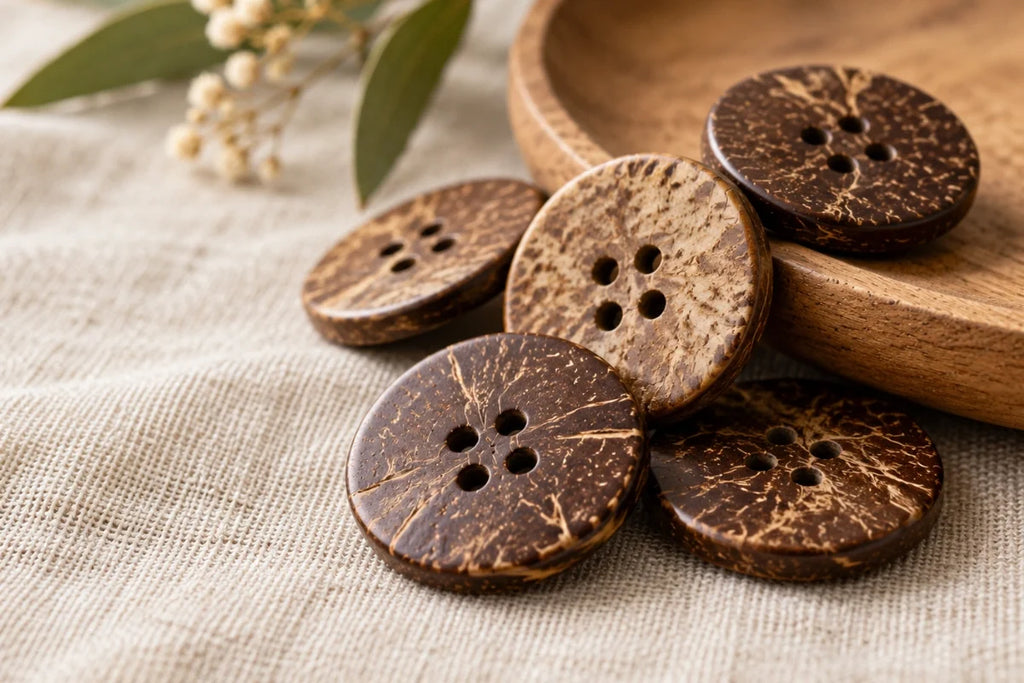
Look closely at the front of a well-made aloha shirt and you may find a small piece of the islands holding it closed. Coconut shell buttons are easy to overlook, but they connect a bright rayon print to the palm tree outside the window, and they have been part of how people describe a "real" aloha shirt for a long time.
Key Takeaways
- Coconut shell is a traditional button material for aloha shirts, and writers have long used it to describe the genuine article.
- Some sellers describe the shell as a by-product of the food industry, which gives these buttons a modest sustainability story.
- No two natural buttons are exactly alike, and that variation is part of the appeal.
- A little care (cool water, no bleach, an iron kept off the buttons) keeps them looking good.
Want the bigger picture first? Read the colorful history and enduring popularity of Hawaiian shirts.
A Tradition That Grew With the Shirt
The idea that a true aloha shirt carries coconut shell buttons is widely repeated. The London Review of Books, for example, describes the buttons of the genuine article as cut from coconut shell (London Review of Books).
That line comes from a 2002 essay, not a rulebook, so it is best read as a picture of how people came to imagine the shirt rather than a manufacturing standard. Plenty of good shirts use other buttons. What is clear is that coconut buttons became part of the picture: vintage-shirt appraiser Dale Hope lists them, along with a "Made in Hawaii" label and a matched pocket, among the details that affect a vintage shirt's worth (Hawaii Business).

From Food By-Product to Button
Some button sellers describe coconut shell as a by-product of the food industry, though we have not found independent data on how much shell ends up as buttons. One supplier directory lists a Cebu button maker that makes shell and coconut buttons from raw materials found in the Philippines (Apparel Search).
Not every "coconut" button is cut straight from a shell. Some craft suppliers sell molded buttons made from reclaimed coconut, one of them containing up to 75% recycled coconut (Dritz). Those are a different kind of product, and they are made with a different process.
The buttons on our aloha shirts are genuine coconut shell, not plastic.
Why They Suit an Aloha Shirt
A button does a quiet job. It should disappear into the outfit and still reward a second look. Coconut shell does this well for a few reasons:
- The color is natural. Browns and warm tans sit comfortably next to almost any print, from deep florals to pale ocean blues.
- It has character. Natural material varies slightly from one piece to the next, so a row of coconut buttons has a hand-finished feel that a mold cannot copy.
- It fits the story. A shirt inspired by island life looks right with a button that comes from an island crop.
If you hold one up to the light, you will usually see a soft, matte surface and small differences in tone from button to button. General guidance on natural shell buttons also notes that they tend to feel cooler and denser than plastic. Those are impressions rather than lab tests, but they are a pleasant thing to notice on a shirt you love.
How to Keep Coconut Buttons Looking Their Best
A little care goes a long way, and the label on your shirt always comes first. Retailer advice on coconut buttons varies: some sellers say they are machine washable with extra care to avoid cracking, others suggest a gentle cycle or hand washing, and one Milward listing specifies a 30°C wash, no bleach, no dry cleaning and no ironing (John Lewis).
For the buttons specifically, this is general guidance for shell buttons, not a manufacturer instruction for our shirts:
- Keep heat off them. Direct contact with a hot iron can discolor or crack shell buttons, so press around them or from the reverse side.
- Go easy on detergent. Strong detergents and bleach can dull a shell's natural finish.
- Check for cracks now and then. Catching a hairline crack early lets you replace one button before it fails in the wash.
For the full routine, including water temperature, drying and storage, see our guide to how to care for aloha shirts.
A Small Keepsake
If your shirt comes with a spare button, keep it. If a button is ever lost or damaged, a spare matches the color and size exactly. Without one, you can match the diameter and number of holes and sew on a replacement.
If you are buying an aloha shirt as a souvenir or a gift, the buttons are a nice detail to point out to the person who receives it. It is a small reminder of where the shirt comes from.
Quick Answers
Do all aloha shirts have coconut buttons?
No. Plastic, resin and other shell buttons are common too, and coconut is a tradition rather than a requirement.
Are coconut buttons sustainable?
Some sellers describe coconut shell as a food-industry by-product, which is a point in its favor. How sustainable any one button is depends on how it was sourced and processed.
Wear a Piece of the Islands
Coconut shell buttons are a small detail with a long story behind them. Have a look at our men's Hawaiian shirts, and take a moment to notice the buttons the next time you pick one up.